Saturday, 10 September 2011

'VINAYAK CHATURTHI

Ganesha Chaturthi, the great Ganesha festival, also known as 'Vinayak Chaturthi' or 'Vinayaka Chavithi' is celebrated by Hindus around the world as the birthday of Lord Ganesha. It is observed during the Hindu month of Bhadra (mid-August to mid-September) and the grandest and most elaborate of them, especially in the western India state of Maharashtra, lasts for 10 days, ending on the day of 'Ananta Chaturdashi'.A life-like clay model of Lord Ganesha is made 2-3 months prior to the day of Ganesh Chaturthi. The size of this idol may vary from 3/4th of an inch to over 25 feet.

On the day of the festival, it is placed on raised platforms in homes or in elaborately decorated outdoor tents for people to view and pay their homage. The priest, usually clad in red silk dhoti and shawl, then invokes life into the idol amidst the chanting of mantras. This ritual is called 'pranapratishhtha'. After this the 'shhodashopachara' (16 ways of paying tribute) follows. Coconut, jaggery, 21 'modakas' (rice flour preparation), 21 'durva' (trefoil) blades and red flowers are offered. The idol is anointed with red unguent or sandal paste (rakta chandan). Throughout the ceremony, Vedic hymns from the Rig Veda and Ganapati Atharva Shirsha Upanishad, and Ganesha stotra from the Narada Purana are chanted.

For 10 days, from Bhadrapad Shudh Chaturthi to the Ananta Chaturdashi, Ganesha is worshipped. On the 11th day, the image is taken through the streets in a procession accompanied with dancing, singing, to be immersed in a river or the sea symbolizing a ritual see-off of the Lord in his journey towards his abode in Kailash while taking away with him the misfortunes of all man. All join in this final procession shouting

"Ganapathi Bappa Morya, Purchya Varshi Laukariya" (O father Ganesha, come again early next year). After the final offering of coconuts, flowers and camphor is made, people carry the idol to the river to immerse it.
The whole community comes to worship Ganesha in beautifully done tents. These also serve as the venue for free medical checkup, blood donation camps, charity for the poor, dramatic performances, films, devotional songs, etc. during the days of the festival.

Swami Sivananda Recommends
On the Ganesh Chaturthi day, meditate on the stories connected with Lord Ganesha early in the morning, during the Brahmamuhurta period. Then, after taking a bath, go to the temple and do the prayers of Lord Ganesha. Offer Him some coconut and sweet pudding. Pray with faith and devotion that He may remove all the obstacles that you experience on the spiritual path. Worship Him at home, too. You can get the assistance of a pundit. Have an image of Lord Ganesha in your
house. Feel His Presence in it.

Don’t forget not to look at the moon on that day; remember that it behaved unbecomingly towards the Lord. This really means avoid the company of all those who have no faith in God, and who deride God, your Guru and religion, from this very day.
Take fresh spiritual resolves and pray to Lord Ganesha for inner spiritual strength to attain success in all your undertakings.

May the blessings of Sri Ganesha be upon you all! May He remove all the obstacles that stand in your spiritual path! May He bestow on you all material prosperity as well as liberation!

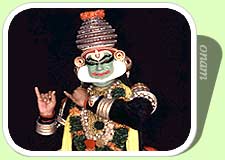
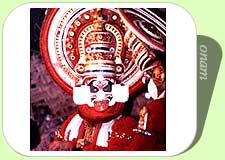
Kathakali

Kathakali

The festival of Onam is blessed with one very striking feather in its cap. The carnival witnesses the performance of unique and unparalleled Kathakali dance-drama. Amongst other places Shoranur, Kovalam and most importantly Cheruthuruthy get the honour of hosting Kathakali shows during the carnival of Onam.

Introduction to Kathakali
'Katha' means story and 'Kali' means dance. As the name suggests Kathakali is a beautiful amalgamation of dance and drama. More precisely, Kathakali is a harmonious blend of five forms of art namely, Sahithyam (literature), Sangeetham (music), Chithram (painting), Natyam (acting) and Nritham (dance). 'Total Theatre' is the word often used to describe this highly evolved art.

Kathakali dance-drama can also be described as a visual art because performers do not say any dialogues in this. Rather they are mime. Communication is made effective through the remarkable use of gestures and mudras. This also lends Kathakali its universal appeal. People of varied tastes all over the world appreciate and admire the beauty of this distinguished art. Another distinct feature of Kathakali is its elaborate costume and make-up. It is a magical sight to watch Kathakali artistes performing in their traditional attire. Their larger than life form transport the audience to a make believe wonderland.

Origin and Theme of Kathakali
Kathakali is one of the most renowned and revered dance-form of India. It originated in southwestern state of Kerala in the town called Travancore some 400 years ago. In a short span, Kathakali has achieved remarkable heights. Kathakali is said to have been inspired from the ancient South Indian dances like Koodiyattam, Krishnanattam, Theyyam, Kalaripayattu besides others. Movements of Kathakali are said to be adopted from Bharatha Natya Shastra with suitable modifications. The drama lends its theme from the stories in Ramayana and the Mahabharata, the famous epics of Hindu mythology. Earlier, only men were supposed to perform this considerably tough classical dance. Nowadays, even women are making a foray and carving their niche in this male dominated field.

Kathakali Music and Narration
Interestingly, there are no dialogues in Kathakali. Story narration and conversation between two characters is done mainly through the gestures made by the performers. Kathakali songs are sung in the background by vocalists, usually two in number. Kathakali lyrics are mostly in the form of verse and sung loudly by Bhagavathar (the vocalist). The unique style of singing adopted for Kathakali is called sopaanam. Kathakali music is provided by two drums known as the chenda and the maddalam. Cymbals and another percussion instrument, ela taalam are also a part of the orchestra. Kathakali

Kathakali Make-up or Aharya
Most remarkable facet of Kathakali dance is its extraordinary and bewitching make-up code. It takes about 8-10 painstaking hours to carry out the elaborate Aharya, (the make-up) in all its detail. Artistes are trained to do the make-up on their own. Notably, there are various colors of make-up for the different shades of character like Pacha, Kathi, Minukku, Thadi etc.
  • Pacha Vehsam (a green make-up) signifies that the artiste is portraying a noble or a divine character, such as that of Lord Rama.
  • Kathi or Knife Vesham (green make-up with streaks of red on the cheeks) is given to character of high birth who have shades of evil, example Ravana.
  • Kari Vesham (black make-up) is used for she-demons.
  • Minukku Vesham (bright yellow make-up) define the character of a woman or an ascetic.
Thadi (Beard) Veshams
  • Chuvanna Thadi (red beards) is given to excessively evil characters.
  • Karutha Thadi (black beard) signifies the character of a forest dweller or a hunter.
  • Vella Thadi (white beard) is given to a superhuman like Hanuman.
Facial paints are prepared by treating rice powder with various colours. Moulded lime is used to extend the contours of the face.

Kathakali Costume
A massive and intricate headgear is the most important part of Kathakali costume. The headgear is prepared from light weight wood. It is embellished with mirrors, colourful stones and pieces of shiny metal plates. Layers of skirts of vivid colours are also worn for buoyancy. Loads of jewelery including anklets, bracelets, big rings and a huge chin caps complete the semblance of a Kathakali dancer. Evil characters also sport talons (big claw like nails) and beards to depict their beastly nature.

Kathakali Training
Training of a Kathakali artiste is extremely strenuous and rigorous. A performer needs to take exhaustive lessons in each and every aspect of this dance-drama. Toughest of all is the physical training which involves control of the muscles mainly that of eye balls, eye brows, eye-lids, lips, neck and shoulder. This is extremely essential part of Kathakali training as in the absence of dialogues, expressions become the most vital aspect of communication in Kathakali dance.

It is also required from the artiste that besides having a thorough knowledge of epics and mythology he must train himself in literature, both Malayalam and Sanskrit. It takes years for an artiste to attain mastery in Kathakali dance. Getting perfection in body movements, footwork and nuances of make-up is also essential. It is said that an artiste who master and synchronizes Nritta (pure dance), Nritya (expression dance), Natya (histrionics), Geeta (vocal music) and Vadya (percussion ensemble) besides literature and painting is the real Kathakali dancer.

KathakaliKathakali Performance
Kathakali performance begin with a musical note called Thiranottam. Before the beginning of the drama a loud thumping of drums can be heard. Most often a peaceful love scene is enacted in the beginning of the show.

Distinctiveness of Kathakali dance lies in the fact that performers do not communicate by means of words. They use the language of hand-gestures, body movements and facial expressions as means of communication. Rigorously trained, performers bring to life mythological tales with ease and e¢lan. Support of vocalist and instrumentalists also play a significant role.

Kathakali dance follows hand gestures prescribed in the book, 'Hasthalakshana Deepika'. Book contains knowledge on 24 basic mudras (hand gestures). Over 470 symbols are derived from these basic hand gestures.

To appreciate this highly evolved Indian classical dance, audience also need to have a basic understanding like background, origin of Kathakali apart from knowledge of legends and mythology.

Changing Trends in Kathakali Performance
Traditional Kathakali performances are long. Starting from the evening, a show continues for the entire night and culminates at dawn. In the modern jet age when people are tight for time, Kathakali has transformed itself. Performances are designed to last for a maximum of two hours these day.

Earlier the performance were held in the courtyards of temples or palaces of Kings of Kerala but now they are held in plush auditoriums for the convenience of the audience.

Traditional performance still take place during the time of festivals in the raised courtyards of temples at Thiruvattar, Thirparappu, Ponmana, Kuzhithurai, Neyyoor and Munchira in the Kanyakumari district.

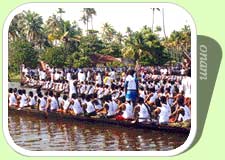
Vallamkali - Boat Race


Vallamkali - Boat Race

Vallamkali or the Snake Boat Race is the most enchanting facet of the festival of Onam. The event is promoted as a major tourist attraction of the state of Kerala and draws a large number of domestic and international tourists. Vallamkali has been going on for good number of years and its popularity is soaring with each passing year. Much credit for the success of Snake Boat Race can be attributed to Pandit Jawahar Lal Nehru who was so enamoured by this colourful event that he instituted a trophy for the race.

The Legend
There is also an interesting legend behind this very electrifying event. The story goes that once about 10 kilometers up the river Pamba from Aranmulla, the head of the Katoor Mana, a Nambudiri family, offered his daily prayers and was waiting to feed a poor man to complete the ritual. After waiting for long, Brahmin closed his eyes and started praying to Lord Krishna. As soon as he opened his eyes, he saw a ragged boy standing before him. The Brahmin lovingly gave a bath to the boy, a new set of clothes and also a sumptuous meal.

To the utter surprise of the Brahmin, the boy vanished after having the meal. He searched for the boy and spotted him at the Aranmulla Temple but the boy disappeared again. Namboodari concluded that it was no ordinary boy, but God himself. To commemorate the event, he began to bring food to the Aranmulla temple every year during the time of Onam. And, to protect the food from the river pirates, Kovilans or snake boats used to accompany the entourage.

As the tradition gained popularity, the number of snake boats increased leading to the custom of a grand carnival called Snake Boat Race.

About the Boat
Vallamkali boat are no ordinary boats and there are fixed measurements to it. It is about 100 feet long and has a seating capacity of 150 men. The boats are usually made of anjili (Artocarpus hirsuta), though sometimes teak and kadamb (Naucleacadamba) wood is also used. The curled ends of the boats are shaped like cobra hoods and it is from this shape that boat has derived its name. Each boat is meticulously crafted by skilled craftsmen and a lot of patience and hard work goes into making and decorating it. The boat is treated as a deity and a holds a lot of emotional value for the village folk. Only men are allowed to touch the boat that too with bare feet. Each boat belong to individual villages located near the river Pamba.

Vallamkali Boat RaceVallamkalis are tastefully decorated with green and scarlet silk umbrellas. The number of umbrellas attached to a boat holds significance as it signifies the affluence of the family to which they belong. To render a more maginificient look to the boat gold coins, ornaments and tassels are also added.

Great care is also taken for the upkeep of the boat. A carpenter repairs the boat on an annual basis. The boats are lubricated with fish oil, coconut shell and carbon mixed with eggs. This also helps to keep the wood strong and boats slippery in water. This way one can always find a boat ready for a swim.

Prior Arrangements
To make sure that everything goes smooth, arrangements start days before the event. The boats are launched a day before the grand racce. Pujas are also rendered to Lord Vishnu and Mahabali by a priest to invoke blessings for the boat and the boatmen. Flowers offered to the God are also placed at the helm of the boat as a good luck charm.

The Boat Race
To watch the grand gala race, thousands of people assemble on the banks of the river Pamba at Aranmulla where a temple dedicated to Lord Krishna and Arjuna is located. About 30 elaborately crafted Chundan Vallams or snake boats participate in the mega event.

The boat race is conducted on a stretch of 40 kilometers from the hills to the low lying plains on the fifth day of Onam. The sight becomes endearing when one looks at the beautifully decorated boats being rowed by oarsmen dressed in white dhotis and turbans. Traditional songs Vanchipattu, sung on the rhythm produced by splashing of boats furthers adds to the overall excitement of the team event.

Each boat comprises of 150 men of which four are helsmen, 25 men are singers and 125 are the actual oarsmen.

The most remarkable feature of the Snake Boat Race is the depiction of the great team spirit. It also displays the importance of being united and to be in harmony with nature. A single mistake by one person can produce imbalance and could lead to the overturning of the boat.

These day even women participate with lot of enthusiasm in the event and a separate race is conducted for them.

Another Legend Associated with the Race
Another tradition of the Onam is that all through the festival days to the eve of Thiru Onam, a boat laden with food, called Palliodam sails from Katoormana. This tradition owes its origin to a legend when a food laden boat got stuck in a turn of river. It could be maneuvered further only when a famished family living in a hut on the banks of the river was well fed with the food in the boat.

Vallamkali Boat RaceThis is related to the Snake Boat Race as the winning boat gets the privilege to accompany Palliodam. The sight is wonderful to look at as the boats are lit with lamps and could be spotted from far. The colorful boat festival is held on the fifth day after Thiru Onam.
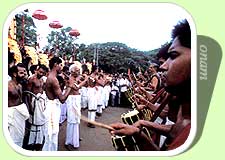
Mersmerised Nehru
A lot of credit for the popularity of the Snake Boat Race can be attributed to the first Prime Minister of the country, Pandit Jawahar Lal Nehru. He was so enchanted by the spirit of the this traditional team event that he decided to promote it in a big way.

He instituted a trophy for the event, which came to be called Nehru Trophy Boat Race. This is an immensely popular event held on the Punnamada Backwaters of Alappuzha district on the second Saturday in the month of August. Started in the year 1952, in an impromptu fashion in honor of the late Prime Minister, Nehru Trophy Boat Race is the biggest team sport event in the world today. A spectacular boat pageantry held before the actual race is the other highlight of the event.
These days several other boat races are also conducted in the various rivers of Kerala and draw massive public attention.

Onam Celebrations

Onam Celebrations

High-spirited people of Kerala celebrate Onam with gaiety and fervor. The festival is celebrated for a period of ten days, starting from the first day Atham and continuing till tenth and the biggest day called Thiru Onam.

The spectacular festival attracts thousands of tourists from across the country and globe. Immense popularity of the festival is further promoted by the Government of India by celebrating Kerala Tourism Week during the time of Onam.

Beginning of the Celebrations
Celebrations of the first day are marked by intricate floral carpets called Pookalam. More flowers of different colours are added to this pookalam on each passing day. Girls take great delight in designing them in the front courtyards of their house. Boys take pleasure in helping them gather flowers. Special prayers are also said on Atham in a local temple. Hectic activities for the carnival begin in the state from this day onwards.

Celebrations on Thiru Onam
The biggest and the most happening day in the carnival of Onam is Thiruvonam. Festivities begin as early as 4 am. People clean up their house, take early bath, wear new clothes and perform elaborate prayers to seek divine blessings. A massive and most exquisite pookalam is prepared on this day to welcome the spirit of King Maveli.

Highpoint of the day is the enormous lunch called Onasadya. People of Kerala are extremely passionate about this. Even if they cannot easily afford, they will anyhow prepare the meal inclusive of all the 11-13 prescribed dishes. This has lead to the saying in Malayalam, "Kanam Vittu Onam Unnanam" which means, "We should have the Thiruonam lunch even if we have to sell all our properties".
Onam Celebrations
Activities, Events and Recreation
There are a lot of activities that takes place all over the state on Onam. Pulikali performers paint themselves in the guise of a tiger and enact hunting scenes to entertain people. Kummattikali artists don an attire of plaited grass and big wooden mask. They move from house to house collecting small gifts and amusing children.

At Thrissur, caparisoned elephants move out in a procession and present a regal view. While at Cheruthuruthy, Kathakali artists cast a spell on the audience with the magic of their performance. Women perform their graceful traditional clap dance, Kaikotikalli on the day and enthrall the audience. Vallamkali, the popular snake boat race is also organised in several parts of the state to mark the day.

Number of sports and games events are also organised on the day. These are collectively called Onakalikal. Some of them are rigorous sports like Talappanthukali, Kutukutu and combats like Kayyankali and Attakalam. Archery is also a part of Onakalikal. Senior members have their share of fun by playing indoor games like cards and chess. There is also a tradition of swinging on Onam. A decorated swing is swung on a high branch and young men and women take the pleasure on it while singing traditional songs.

ONAM

What is Onam?

Onam is the biggest and the most important festival of the state of Kerala. It is a harvest festival and is celebrated with joy and enthusiasm all over the state by people of all communities. According to a popular legend, the festival is celebrated to welcome King Mahabali, whose spirit is said to visit Kerala at the time of Onam.

Onam is celebrated in the beginning of the month of Chingam, the first month of Malayalam Calendar (Kollavarsham). This corresponds with the month of August-September according to Gregorian Calendar.

Carnival of Onam lasts from four to ten days. First day, Atham and tenth day, Thiruonam are most important of all. Popularity and presentation of rich culture of the state during the carnival made Onam the National Festival of Kerala in 1961. Elaborate feasts, folk songs, elegant dances, energetic games, elephants, boats and flowers all are a part of the dynamic festival called Onam.

Government of India has taken due notice of this vibrant and colorful festival. It promotes Onam internationally in a big way and celebrates 'Tourist Week' for Kerala during Onam celebrations. Thousands of domestic and foreign tourists visit Kerala to be a part of Onam.

The Legend
Story goes that during the reign of mighty asura (demon) king, Mahabali, Kerala witnessed its golden era. Every body in the state was happy and prosperous and king was highly regarded by his subjects. Apart from all his virtues, Mahabali had one shortcoming. He was egoistic. This weakness in Mahabali's character was utilized by Gods to bring an end to his reign as they felt challenged by Mahabali's growing popularity. However, for all the good deed done by Mahabali, God granted him a boon that he could annually visit his people with whom he was so attached.

It is this visit of Mahabali that is celebrated as Onam every year. People make all efforts to celebrate the festival in a grand way and impress upon their dear King that they are happy and wish him well.

Onam Celebrations
Rich cultural heritage of Kerala comes out in its best form and spirit during the ten day long festival. It is indeed a treat to be a part of the grand carnival. People of Kerala make elaborate preparations to celebrate it in the best possible manner.

The most impressive part of Onam celebration is the grand feast called Onasadya, prepared on Thiruonam. It is a nine course meal consisting of 11 to 13 essential dishes. Onasadya is served on banana leaves and people sit on a mat laid on the floor to have the meal.

Another enchanting feature of Onam is Vallamkali, the Snake Boat Race, held on the river Pampa. It is a colourful sight to watch the decorated boat oared by hundreds of boatmen amidst chanting of songs and cheering by spectators.

There is also a tradition to play games, collectively called Onakalikal, on Onam. Men go in for rigorous sports like Talappanthukali (played with ball), Ambeyyal (Archery), Kutukutu and combats called Kayyankali and Attakalam. Women indulge in cultural activities. They make intricately designed flower mats called, Pookalam in the front courtyard of house to welcome King Mahabali. Kaikotti kali and Thumbi Thullal are two graceful dances performed by women on Onam. Folk performances like Kummatti kali and Pulikali add to the zest of celebrations.

Thursday, 1 September 2011

MANTHRIYUDE DHUKKAM- Poem

ഈനാംബെച്ചി മരിച്ചുവോ ഹ ഹ ! ജനം കേഴുന്നു,
വന്‍ നഷ്ടമായ് 
 ഞാനും ഞെട്ടി , വിറച്ചു , മാമകവലം -
കയ്യിന്നോടിഞ്ഞൂ ദൃഡം .
മാനത്തോലമുയര്ന്നതായൊരു മഹാസൌധം 
പണിഞ്ഞിട്ടു നാം 
 ജ്നാനിശ്രേഷ്ടനിവന്റെ പേരിലോരുനല്‍
കാവ്യം രചിച്ചീടനം .
                                                                                                                  -സി.വി.ഗോവിന്ദന്‍ നമ്പൂതിരി 
courtesy: JOURNAL, Trichur Training Collage

CRUCIFIXION...............

I experience

My past,present &future
In a single sleep
My bitter days of childhod,
Better days of youth,
And the worst inexperienced days of old age.

Many a times have i died in my sleep;
but when awoke,saw the ghost
Which terrified none but myself.

Something bulges on my right cheek
It grows & grows
Till it makes my face look ugly.

I mistakes my dream for life
I run to mirror crying aloud
But what a wonder!there is nothing on my face.
Is it a vision of my future,or just an anxiety neurosis?

I don't know.

I fear Death! I hope desperately
She  will not cover me in her blanket.
But i know ,this stunted tree will be uprooted soon.

I have experienced everything a man should
And i fear the cup filled with my life
Will fall & shatter on the ground at any moment.


ONNU NILKKANE . . .


ഒന്ന് നില്‍ക്കണേ ദേവീ ഞാനൊന്ന് പുനര്‍ന്നോട്ടെ
പിന്നെ നീ തുടര്‍ന്നോളൂ ഗമനം മുന്നെപ്പോലെ
പുത്തനാടകള്‍ നിത്യം മാറി നീ ചമയുമ്പോള്‍
അറിയുന്നീലാ നിന്നെ എങ്ങനെ പൂകെണ്ടൂ ഞാന്‍
വാത്മീകിയന്നേകിയ വല്‍ക്കലം മാറ്റിപ്പുത്തന്‍
മുണ്ടും വേഷ്ടിയും കാളിദാസനോ നിനക്കേകി
കുഞ്ചാ, തുഞ്ചന്മാര്‍ തന്ന സാരിയില്‍ നിന്നെക്കണ്ടൂ
അന്നൊന്നും പൂകാന്‍ നിന്നെ കഴിഞ്ഞില്ലെനിക്കൊട്ടും
പിന്നെ ഞാന്‍ കണ്ടൂ നിന്നെ ആശാനും വള്ളത്തോളും
ഉള്ളൂരും ചുറ്റിപ്പറ്റി ശ്രുംഗരിച്ചീടുന്നതായ്
ആശിച്ചു ഞാനന്നൊന്നുമടുക്കാന്‍ കഴിഞ്ഞില്ല
ഇന്നിതാ നിന്നെക്കാനുന്നത്യന്താധുനികത്തില്‍
അയ്യപ്പപ്പനിക്കാരും കൂട്ടരുമനിയിച്ച
വേഷത്തിലഹന്തയാര്ന്നമാരും നിന്നെപ്പൂകാന്‍
കൊതിക്കുന്നെന്നെത്തെല്ലോന്നടുപ്പിക്കണേ ദേവീ
ഒന്ന് നില്‍ക്കണേ ദേവീ ഞാനൊന്ന് പുനര്‍ന്നോട്ടെ!!!
                -(Late)പി.കെ.ഫ്രാന്‍സീസ് മാസ്റ്റര്‍,
                  ചിമ്മന്‍ ഹൌസ്,
                  ചിറ്റാട്ടുകര,
                  തൃശ്ശൂര്‍.